Part 1: The Shattered Chandelier
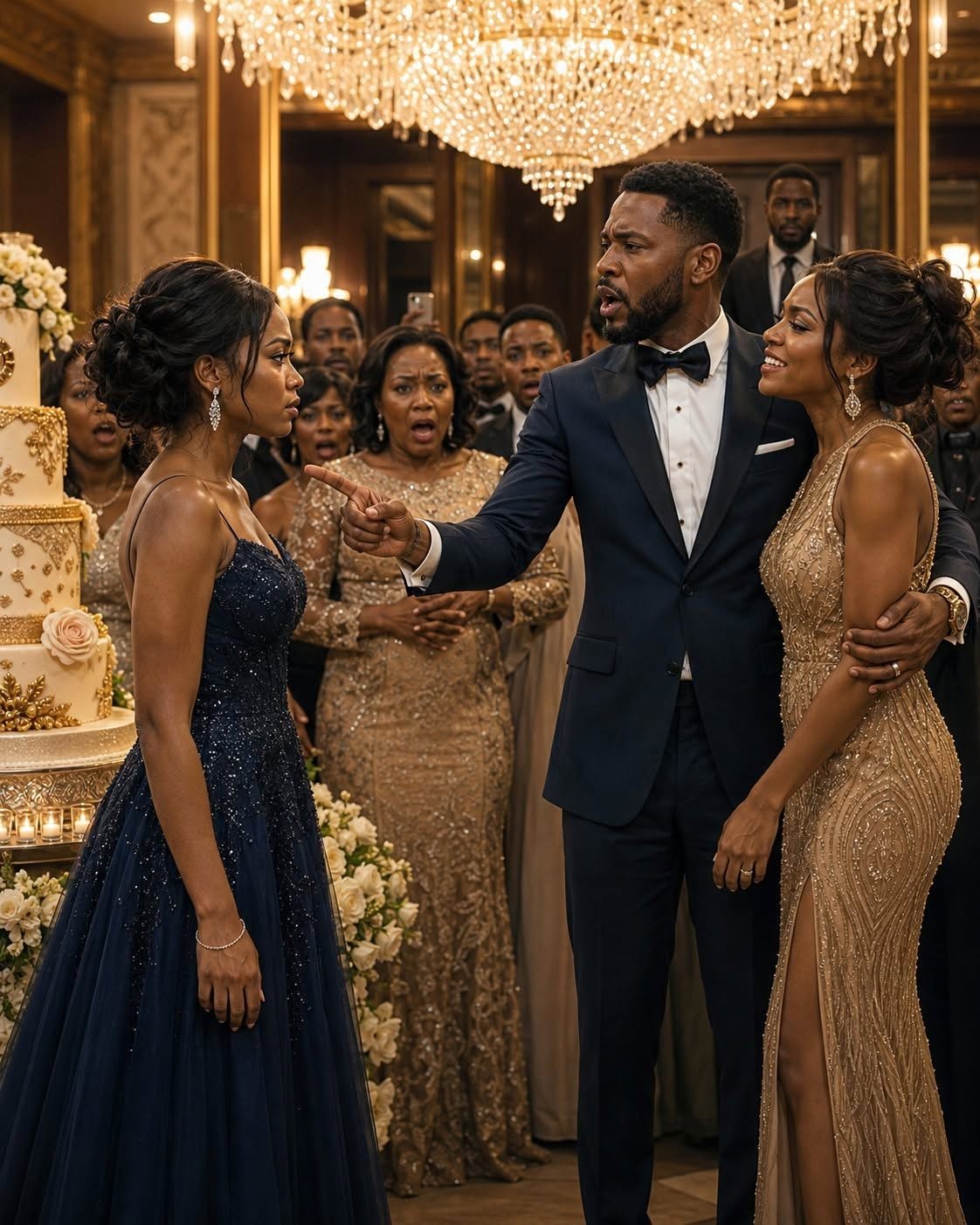
The music was still playing when the humiliation began. In the center of a glittering engagement party in the affluent Plateau district of Dar, Fannah sat beside a towering multi-tiered cake, her diamond engagement ring catching the bright, blinding chandelier light. Guests held expensive champagne glasses, smiling warmly for the roving photographers until Musa suddenly raised his voice.
“Everyone,” he announced, his tone terrifyingly calm, cutting through the jazz quartet like a blade. “There has been a small change.”
A strange, suffocating silence fell across the crowded room. The clinking of crystal ceased. Then, with deliberate slowness, Musa pulled Awatis—Fannah’s own younger sister—closer to his side. His hand rested firmly on the small of her back.
“The woman I’m marrying,” he stated, “is Awa.”
Gasps rippled through the crowd like an electric current. Cell phones lifted instantly to capture the spectacle. Some people in the back even laughed, assuming it was a tasteless, drunken joke. Fannah didn’t move. She couldn’t. Her body felt as if it had been poured full of wet cement. Her mother leaned toward her from the adjacent table and whispered with chilling, desperate coldness, “Don’t you dare embarrass this family. Keep smiling.”
And near the ornate double doors, standing quietly in simple, faded clothes, a man named Ibrahima Dio watched the entire betrayal unfold with dark, unreadable eyes.
Fannah had learned very early in life that dignity was something you carried securely inside your own spirit, because a harsh world could strip you of almost everything else. In the crowded, unforgiving streets of Dar, dignity didn’t come from the expensive cut of your dress or the shiny brand of your phone. It came from whether you could still stand tall when the city decided to look right through you like you were invisible.
She lived in Parcel Lasenis in a cramped two-room apartment with peeling paint and a rusted window that never truly closed all the way. In the heavy rainy season, the wind pushed dampness directly through the concrete cracks, and Fannah would wake up to find her work clothes faintly wet on the indoor line. Still, she woke before sunrise every single day, tied her headscarf with practiced care, and stepped out into the chaotic streets with a quiet seriousness that made people trust her even before she spoke.
At twenty-seven, she wasn’t the kind of woman who chased cheap attention. She wasn’t loud in the way some women in the city felt they had to be just to survive the daily noise. Fannah’s strength was steadier than that, like a deep river that kept moving forward even when massive rocks tried to dam its course.
She worked as an administrative assistant for a mid-sized logistics company near Plateau, handling complicated invoices, urgent shipments, calls from impatient clients, and the constant, grinding chaos of a transport sector that never truly slowed down. Her salary wasn’t large, but she managed it with iron discipline. She paid her rent on time. She bought her modest groceries. She faithfully sent a portion of her earnings to her father’s younger brother in Kyak, who had taken in Fannah’s young cousin after their aunt had passed away from an illness they couldn’t afford to treat.
And, of course, she helped her mother.
Her mother, Marama Tisy, lived not far away in a packed family compound where every single adult carried invisible, daily stress like a second shadow. Marama was the type of matriarch who measured love entirely in silent sacrifices. She believed that a spotless family reputation was the only shield a household had against abject poverty, and she held that shield up with both hands, even if the edges cut deeply into her palms.
Fannah understood her mother’s constant fear. In their district, one scandalous rumor could ruin a woman’s prospects in a single afternoon. A whisper could close doors before you even had the chance to knock. Still, Marama’s maternal love had always come with incredibly sharp edges, heavily favoring the squeaky wheel.
And Fannah’s younger sister, Awatis, was built very differently. Not in body, but in a deep, gnawing hunger for more. Where Fannah moved through the world with careful, earned dignity, Awa moved like someone who fundamentally believed that the universe owed her a debt. She was charming in public, quick with flowery compliments, and loud with infectious laughter. People gravitated toward her because she made them feel instantly important.
But behind closed doors, in the peeling apartment, Awa’s dark eyes often lingered on Fannah’s modest life like she was mentally inventorying what belonged to her.
“You act like you’re better than everyone else, just because you have a desk job,” Awa would say sometimes, leaning aggressively against the doorway while Fannah diligently folded the laundry.
“I don’t,” Fannah would reply quietly, refusing to take the bait and start an argument.
Awa would scoff, rolling her eyes. “Then why are you always the one mama praises when people from the neighborhood come around?”
Fannah never answered that either. She had realized long ago that envy didn’t require logic or fair play. It only required an opportunity. And tonight, that opportunity had arrived in a tailored navy suit.
Musa Nadier was everything the upper crust of Dar respected. He wore bespoke Italian suits even on casual weekdays. His gleaming wristwatch alone could easily pay someone’s yearly rent in Parcel Lasenis. He drove a massive black SUV that looked like it belonged to a government minister. People didn’t ask impertinent questions about men like Musa; they simply assumed that immense success and wealth had been his birthright.
He was thirty-two and already commanded a rising name in the business world—real estate, imports, investments. They were the kind of buzzwords that made older, wealthy men nod approvingly whenever he walked into a private club. Even people who pretended to be above the fray would unconsciously adjust their posture when Musa was near.
Fannah had met Musa through her logistics job. Her company handled complex shipping clearances for one of his massive commercial projects, and he had come to the administrative office one afternoon when a critical delivery of steel beams was severely delayed.
Most wealthy clients would have shouted, threatened lawsuits, or degraded the staff. Musa didn’t. He had stood calmly at the reception desk, as cool as if he owned the entire tower, and asked in a conversational tone, “Who is responsible for this account?”
Fannah had stepped forward, her heart beating a steady rhythm. “I am.”
He had looked at her—really looked into her eyes—and then nodded slowly. “Fix it, please.”
There was no insult in his deep voice, no disrespect, just an unspoken expectation of competence. She had fixed the bureaucratic tangle not out of fear of his wealth, but out of deep pride in her daily work.
After that, he began to appear at the office much more often, sometimes for trivial business, sometimes for reasons that felt less clear. He asked her personal questions that had nothing to do with shipping manifests. He asked where she grew up, if she liked the ocean, whether she ever took time to properly rest.
At first, Fannah had stayed heavily guarded. Men with excessive money often mistook basic workplace kindness for romantic weakness. But Musa was remarkably patient, and he was exceedingly careful with his honeyed words. When he finally asked her out on a proper date, he didn’t do it with a flashy display. He had said, “I’ve been watching the way you carry yourself with such grace. I’d like to know you outside this office, if you’ll allow it.”
Allow it. The phrasing made her pause because it sounded suspiciously like genuine respect. So, she had said yes.
Their first date was at a quiet, seaside restaurant in Almades where the salty ocean breeze softened the aggressive city noise. Fannah had worn a simple, inexpensive dress and felt thoroughly out of place among the polished tables and wafts of expensive cologne. But Musa had made her feel uniquely seen. He asked for her opinions on architecture, on politics, and he actually listened to her replies. He didn’t act like her humble background was a stain on his pedigree.
As weeks steadily turned into months, Musa became a permanent, intoxicating presence in her life. He called her late at night, sent his private car to pick her up when she worked late, and invited her to high-society events where people looked at her with a mix of awe and burning curiosity.
And the more Musa’s attention settled on Fannah, the more her family’s attention drastically shifted, too.
Marama began to call her phone multiple times a day, her voice dripping with sudden, unearned warmth. “My daughter, are you eating well? Are you saving your money for the future? Remember, a man of his stature does not come twice to a compound like ours.”
Awa’s behavior, however, had changed most of all. At first, she acted aggressively supportive. Too supportive. She wanted to know every single detail of their romance—where they went, what he said, what lavish gifts he bought her.
“Bring him to the compound for a family dinner,” Awa had insisted one afternoon, her eyes glittering. “Let the elders see you’re serious. Let them respect you properly.”
Fannah had hesitated. “Musa is an incredibly busy man, Awa.”
Awa had rolled her eyes, a flash of her true nature showing. “Busy men still make ample time for what they actually value. Or are you afraid?”
Afraid of what, Fannah had wondered. But to keep the peace and avoid her sister’s nagging, she had eventually agreed to a formal family meeting at the compound.
Musa had arrived wearing a simple, unbranded kaftan instead of his usual power suit, politely greeting the elders with traditional deference. He spoke carefully, offered expensive gifts to the uncles, and promised them all serious intentions toward her. The older women had beamed, and the male elders had nodded with deep approval. Marama had glowed that afternoon like a woman whose prayers had finally been answered after decades of poverty.
After Musa had left, the dusty compound had buzzed with excited gossip. Some neighbors congratulated Fannah on her incredible catch. Others whispered behind their hands, trying to measure her basic worth against his unfathomable wealth. Fannah had kept her head down and pretended not to hear the whispers.
That night, when she returned to her quiet, damp apartment, she had allowed herself to dream—quietly, very cautiously. Maybe her luck was finally turning. Maybe her long, unspooled years of carrying financial burdens for the family would finally lead somewhere soft and secure.
Three months later, Musa had proposed. It wasn’t with fireworks or a crowded public spectacle. It was in his leather-scented SUV parked quietly near the Cornesh, the dark ocean stretching out behind them. He had clicked open a velvet ring box and said, “Fannah, I want to build a life with you. Will you do me the honor of marrying me?”
Her throat had tightened with emotion. She remembered her father, taken by an illness they couldn’t afford to treat properly when she was only nineteen. She remembered her mother’s permanent fatigue, her cousin’s mounting school fees, and her own crushing loneliness in a massive city full of indifferent people.
So, she had looked into his dark eyes and said, “Yes.”
When she broke the news to Marama, her mother had wept. They weren’t gentle, happy tears, but the kind of racking sobs that sounded like the release of a generational curse. “This is God,” Marama had declared, clutching her chest. “This is our ultimate breakthrough.”
Awa had hugged her as well, laughing a little too loudly. “My sister will be Madame Nadi. You see, our family is finally rising above the dirt.”
But when Fannah had looked deeply into Awa’s eyes, she had seen something unnameable. It wasn’t sisterly joy. It was sharp, cold, and calculating—like an apex predator whose hunger had suddenly found a clear direction.
Fannah had tried to push the dark intuition away. Engagement preparations had moved at breakneck speed. Musa had demanded a massive celebration, an event that felt far more like a corporate statement than a joyous family gathering. It was booked at an elite, glass-fronted venue in Plateau, to be populated by his aggressive business associates, high-society women, and extended family. It was the glossy kind of event people paid thousands to document online, the kind that made strangers sigh and say, “That’s the life I want.” Fannah didn’t care for the theatrical display. But Musa had insisted. “It’s not just about us, Fannah,” he had reasoned, touching her cheek. “It’s about publicly showing the city that I am serious about this union.”
Her mother had been even more forceful. “Let them see exactly who you are marrying,” Marama had instructed. “Let them see that you are highly chosen.”
So, Fannah had allowed herself to be swept along by the tide. She had purchased yards of expensive emerald fabric for a traditional gown. She had saved her secret administrative wages for professional makeup and hair. She had even practiced soft smiles in her bathroom mirror, not out of vanity, but because she was terrified of looking ungrateful or awkward in front of people who already doubted her belonging.
Still, the knot of unease in her stomach had refused to dissolve.
In the week leading up to this grand engagement party, Musa had become incredibly difficult to reach. His daily calls had vanished, replaced by short, delayed texts. Whenever she asked if everything was going well with his developments, he would reply breezily, “Business stress, sweetheart. Don’t worry about it.”
Awa, on the other hand, had been suddenly everywhere. She had insisted on helping with the emerald outfit, practically forcing them to go together for late-night fittings, taking candid photos on her phone, and uploading them to social media with cryptic, oddly possessive captions.
“Bring him to the compound one last time before the Plateau party,” Awa had insisted one evening. “Let people see you two together.”
“Musa is working late contracts all week, Awa,” Fannah had deflected.
“A man makes time for his fiancée,” Awa had snapped, a flash of venom in her voice.
Then, on the Tuesday evening prior to the blowout, Fannah had entered her mother’s compound unannounced and caught Awa in a dark corner of the courtyard, hissing into her mobile phone. When Awa had seen her older sister, she had terminated the call instantly, her face flushing as she plastered on a smile that was far too wide.
“Who were you talking to so secretly, Awa?” Fannah had asked, trying to keep her voice level.
Awa had shrugged, her eyes darting away. “Just a friend.”
“What friend?”
Awa had let out a shrill laugh that made the hairs on Fannah’s arms stand up. “Ah, Fannah, you ask far too many questions. Relax. You are about to marry a billionaire. Go home and enjoy your good fortune.”
Fannah had forced a weak smile, but the cold weight in her gut had tightened into a vice. That night, she had lain awake in her narrow bed, listening to the far-off hum of Dar’s torrential rain. She had stared at the peeling ceiling, desperately trying to calm her racing thoughts. Maybe she was just suffering from pre-wedding jitters. Maybe she was letting her deep-seated insecurities ruin a beautiful stroke of destiny.
Then, her phone had chimed against the nightstand. A text message from the man she was supposed to spend her life with.
We’ll talk tomorrow. Everything will be fine. There was no affectionate heart emoji. There was no ‘my love’ or reassuring endearment. Just a cold, sterile dismissal. Fannah had rolled onto her side, hugging a pillow to her chest, whispering into the dark, “It will be fine.” Yet, as the words left her lips, her intuition screamed that the foundation was about to cave in.
And now, standing beside the towering multi-tiered cake, the flashbulbs blinding her, the music dying down, the ultimate betrayal had arrived. Musa had bypassed her entirely, pulling her smiling sister into his embrace, announcing to three hundred of the city’s elite that he was taking her place.
Fannah stood frozen on the stage, the shock waves rippling through her nervous system. She glanced toward the doorway one last time, locking eyes with the quiet man in the simple clothes, feeling her perfectly constructed reality turn to ash in an instant.
Part 2: The Logic of Envy
The silence in the glittering ballroom was absolute—the kind of dense, suffocating quiet that precedes an explosion. Fannah stood near the towering cake, heremerald-green dress suddenly feeling like a suit of lead. The camera flashes continued to pop, their mechanical clicks sounding like malicious laughter in her ears.
She looked at Musa. His face was a mask of cold, corporate indifference. He looked at her the way he might look at a shipping manifest that had been cancelled due to a logistical error. He didn’t drop his gaze. He simply stood there, his arm wrapped firmly around Awatis’s waist, radiating the absolute certainty of a man who believed his wealth insulated him from any consequences.
Awa leaned her head against his tailored shoulder, projecting a radiant, triumphant smile for the recording phones of the society bloggers. In that singular, agonizing second, Fannah understood the depth of the conspiracy that had been unfolding under her nose. The missed calls, the delayed texts, the late-night fittings where Awa had insisted on taking pictures—it had all been a play, orchestrated to maximize the public humiliation.
Marama pushed her way through the front row of tables, her expensive brocade wrapper rustling aggressively. She reached out and grabbed Fannah’s bare wrist, her fingers digging in with desperate, maternal panic.
“Fix your face,” Marama hissed through clenched teeth, her eyes wide with terror as she stared at the surrounding elites. “Do not let them see you fall apart. Smile for the crowd, Fannah. Do not embarrass this family.”
“Embarrass the family?” Fannah repeated, her voice sounding as if it were coming from the bottom of a deep well. The absolute absurdity of the plea struck her like a physical blow. Her mother wasn’t angry at the man who had broken a sacred promise. She wasn’t furious at the daughter who had stolen an engagement. She was terrified of the gossip. She was terrified of the social downgrade.
“Listen to your mother, Fannah,” an oily voice chimed in. It was Uncle Ibrahim, stepping up behind Marama. “Awa is the one wearing the ring now. Make a graceful exit. Let them have their moment.”
Graceful exit. The phrase dropped like an iron weight. They wanted her to fold up her dignity, put on a polite face, and disappear into the rainy night like a servant dismissed from a banquet hall.
Fannah looked at the crowd. The whispering had started up again, a low, buzzing hive of speculation. Some of the younger socialites were openly smirking, their eyes darting between the discarded fiancée and the new, glittering couple on the stage.
“She really thought she was going to be Madame Nadier,” someone murmured from table nine, just loud enough to carry across the parquet floor. “Can you imagine the delusion?”
The humiliation burned across Fannah’s cheeks, a hot, blistering wave of adrenaline. For a fleeting second, the darkness at the edge of her vision threatened to pull her under. But then, a strange, cold clarity washed over the heat.
She looked down at her hand. Her finger was bare. She had taken the diamond ring off her finger that very morning because it had felt slightly too loose, intending to have a jeweler resize it on Monday. It was as if her subconscious had known what her conscious mind had refused to accept.
She didn’t cry. She didn’t scream at Awa, nor did she throw a glass of champagne at Musa’s tailored suit. That was what they had scripted for the evening’s entertainment. That was the “delusional, hysterical, bitter ex-fiancée” performance they had bought tickets to see.
Instead, Fannah withdrew her wrist from her mother’s desperate grip. She took a slow, deep breath, expanding her lungs, feeling the absolute power of an empty stage. She smoothed down the rich emerald fabric of her dress, adjusting the gold accessories in her braids with deliberate, unhurried grace.
She didn’t look at Marama again. She didn’t look at the stage.
She turned away from the blinding chandeliers and began to walk toward the glass exit doors. Her steps were measured, rhythmic, and proud. She moved through the sea of wealthy, judgmental patrons with the steady, unyielding momentum of a tide retreating from the shore. The murmuring in the room died down as she passed, replaced by a tense, uneasy quiet. They had expected a scene; they were receiving a silent, devastating indictment of their world.
As she pushed through the heavy glass doors out into the cooling night air, she heard Awa’s voice ring out one last time, shrill and triumphant. “Thank you all for understanding! Let the music play!”
The jazz quartet struck up a lively, synthetic tune, attempting to paper over the crack in the evening’s foundation. But for Fannah, the music faded into an insignificant hum the second the cool, salty breeze of the Atlantic washed over her heated skin.
She descended the sweeping marble steps, her high heels clicking a steady rhythm against the stone. The rain had cleared, leaving the streets of Plateau slick and reflective under the streetlights. She walked past the row of gleaming luxury SUVs, a solitary figure in an emerald gown, suddenly feeling incredibly light.
A silver sedan idled near the valet stand. The quiet man in the simple, faded clothes—the one who had watched the entire tragedy from the shadows near the doorway—was leaning against the fender, smoking a thin cigarette. As Fannah approached, he dropped the ash and stood up, his unreadable eyes meeting hers once more.
“It’s a long walk to Parcel Lasenis in those shoes, Miss Tisy,” Ibrahima said, his voice quiet, carrying the weight of a man who knew exactly what the night had cost her.
Part 3: The Stranger’s Coat
Fannah stopped three paces from the silver sedan. She was exhausted, emotionally drained, and acutely aware that her life had just been dismantled on public display. Yet, looking at this stranger—a man who worked with his hands, who had no expensive watch, no tailored suit, and no social standing in Dar—she felt an inexplicable sense of safety.
“How do you know my name?” she asked, her voice raspy.
“I told you,” Ibrahima replied simply, crushing the cigarette butt under his worn shoe. “I make it my business to observe things that others overlook. You are not invisible to everyone, Fannah.”
The use of her first name without a title should have felt inappropriate, but in the vast, cold expanse of the Plateau night, it felt like a warm anchor.
“They laughed at me,” she said, the admission slipping out of her before she could stop it. The dam of her restraint cracked slightly. “My own sister… my mother… they told me to leave quietly so I wouldn’t embarrass the family.”
Ibrahima nodded slowly, his dark eyes reflecting the neon signs of the distant storefronts. “They are playing a game where the rules are written by people who own nothing but their pride. If you step outside their arena, their rules no longer apply to you.”
“But I have to live in Dar,” she countered, a flash of bitterness returning. “A scandal like this… rumors will close every door before I even have the chance to knock. I’ve lost my reputation.”
“A reputation built on who you are engaged to is merely an illusion,” Ibrahima said, opening the rear passenger door of the modest silver car. “Come. Let me take you away from this place. You do not need to stand on the pavement while they write the next chapter of your tragedy.”
Fannah hesitated, her survival instincts flaring. Getting into a car with a strange man in the middle of the night went against every safety rule her mother had drilled into her head. But what did she have to lose? The fairy tale was dead.
She slid across the soft leather seat, the interior smelling faintly of cedar and clean rain. Ibrahima closed the door gently and slid into the driver’s seat. The engine purred to life with a quiet, refined power that seemed entirely inconsistent with the faded exterior of the vehicle.
They drove through the palm-lined streets of Plateau, the glittering skyline of Dar sliding by in a blur of crimson and gold. Fannah rested her head against the cool glass of the window, watching the city lights.
“Where are we going?” she asked quietly.
“To a place where the air is clear,” Ibrahima said, navigating the winding coastal road toward the outskirts of Almades.
After twenty minutes of silence, the car turned down a dark, unpaved lane and stopped before a low, whitewashed house sitting on a low cliff overlooking the roaring Atlantic. It wasn’t a mega-mansion, nor was it a decaying tenement. It was a beautiful, secluded home built with local stone and dark wood, radiating an aura of profound, unbothered peace.
“Whose house is this?” Fannah asked, stepping out of the car, the salty breeze whipping her emerald dress.
“Mine,” Ibrahima said, walking over to unlock the heavy wooden front door.
Fannah followed him into a warm, softly lit foyer filled with books, maps, and simple, elegant furniture. There were no crystal chandeliers, no gold leaf, no ostentatious displays of wealth, but everything was authentic and crafted withtotal care.
Ibrahima walked over to a small kitchenette and set a copper kettle on the stove. “Sit, Fannah,” he instructed, taking off his jacket to reveal a plain black shirt. Without the jacket, the broadness of his shoulders and the commanding, unhurried way he moved through the space became even more apparent.
He didn’t act like a driver, or a delivery worker, or a man of low station. He moved like someone who owned the very ground the house was built upon.
“You’re not who you pretend to be,” Fannah said, sitting at the polished oak dining table, her eyes tracking his every move.
Ibrahima turned, holding two ceramic mugs. He set one down in front of her, the steam curling upward. “I don’t pretend to be anyone, Fannah. I simply choose not to advertise my reality to people who are only interested in the label.”
He sat down opposite her, his icy gray eyes locking onto hers. “My name is Ibrahima Dio. I am the managing director of Dio Strategic Holdings.”
The words landed with the weight of a sledgehammer. Fannah’s jaw dropped. Dio Strategic Holdings. The name was legendary in West African business circles. They controlled major shipping ports, logistics infrastructure, and mining investments across the continent. The man sitting across from her in a faded shirt was a corporate titan—a billionaire whose influence dwarfed Musa Nadier’s aspirations by a factor of ten.
“You’re…” Fannah stammered, her mind spinning wildly out of control. “You’re the man who… the investor who just bought out the port authority in Dakar.”
“Yes,” Ibrahima said calmly, taking a sip of his tea.
“But… but why were you at the engagement party? Why were you standing near the doorway in those clothes?”
“I was there because Musa Nadier has been trying to secure a logistics contract with my firm for six months,” Ibrahima explained, his tone hardening slightly. “He invited me to the party, claiming it was a high-level business gathering. I wanted to see shadow play shadow. I wanted to see how a man who claims to be a visionary behaves in his personal life before I entrust him with millions of dollars of infrastructure capital.”
Fannah felt her breath catch. “And you saw.”
“I saw everything,” Ibrahima said, his gaze softening as he looked at her. “I saw a man driven by shallow pride, and I saw a woman who carried herself with an unbreakable dignity while her world was being ripped apart by vultures.”
“He took everything from me,” Fannah whispered, looking down at her hands, the memory of Awa’s triumphant smile burning in her mind.
“He took an illusion,” Ibrahima corrected her, reaching across the oak table to lightly touch her knuckles. His touch was warm, solid, and entirely real. “He left you with your actual self. That is not a loss, Fannah. That is a brutal, but necessary, clearing of the wreckage.”
Fannah sat in the quiet, dim Almades house, listening to the roar of the ocean outside. Her life had turned completely upside down in the span of three hours. The pain of the betrayal was still there, a raw, open wound, but beside it sat the dizzying, terrifying possibility of an entirely new destiny.
Part 4: The Warehouse Takeover
In Dakar, news travels faster than the Atlantic wind, and by the third day after the engagement party disaster, almost everyone who moved within the high-society circles of Plateau and Almades knew the dramatic story. But like most tales told by self-important people, the truth had already been twisted into something unrecognizable and cruel.
Some vicious versions of the gossip claimed Fannah had been too basic, too “unrefined” for Musa’s soaring business ambitions. Others whispered that Musa had discovered a dark, disqualifying secret about Fannah’s family that made him change his mind at the last possible second. A few particularly malicious bloggers even suggested that Fannah had tried to trap the wealthy real estate mogul into marriage using underhanded tactics, and that Awa had heroically stepped in to save the day.
None of those rumors carried a single shred of truth, but in the ruthless social ecosystem of the capital, a juicy scandal was always louder and more pervasive than objective facts.
That sunny Monday morning, Fannah sat at her small, cluttered desk in the administrative department of a mid-sized shipping and logistics firm near the port—the company where she had worked diligently for four solid years. The familiar hum of desktop computers and the ringing of multi-line phones filled the bustling room, but the atmospheric register of the office had undergone a radical, chilling shift.
People looked at her differently when they thought she wasn’t paying attention. It wasn’t openly hostile, not yet; it was much worse. It was careful. Tiptoeing. Two of her co-workers, women she had shared Friday pastries and wedding planning gripes with for two years, were currently whispering near the industrial printer. The exact second Fannah raised her eyes to check a shipping manifest, they snapped their mouths shut and stared fixedly at a stack of blank paper.
Fannah pretended she hadn’t noticed their freeze. She forced her focus onto the customs invoices piling up in her inbox, typing the complex tracking numbers into the mainframe with steady, unbothered fingers.
Her work had always been her primary sanctuary. As long as she could concentrate on the physical mechanics of processing shipments and balancing accounts, she could keep the jagged edges of her humiliation locked securely behind a mental bulkhead. But around mid-morning, her direct supervisor, Mr. Sarr, appeared beside her swivel chair with a troubled expression.
“Fannah,” he said quietly, avoiding direct eye contact. “Can you step into my glass office for a moment?”
Her stomach plummeted. “Of course, Mr. Sarr.”
Inside the cramped, sun-baked office, the supervisor closed the heavy door with deliberate care. He was a middle-aged man who usually spoke with straightforward, avuncular kindness, but today his face looked pinched and deeply uncomfortable.
“Please, have a seat,” he offered, gesturing to a folding chair.
Fannah sat down, folding her hands over her lap.
Mr. Sarr cleared his throat, adjusting a stack of papers on his desk. “As you know, our logistics firm handles contracts for several major infrastructure developers in the city.”
“Yes, Mr. Sarr.”
“One of our most critical accounts is NDI Construction Group. Run by… well, by Musa Nadier.”
The mention of his name felt like a physical slap to her face, but Fannah didn’t blink. She kept her chin high.
“Musa called my office late yesterday afternoon,” the supervisor continued, sweating profusely now. “He… he strongly suggested that your ongoing employment here might create unnecessary administrative complications for our shipping partnership going forward.”
The corporate doublespeak was crystal clear. It was a velvet glove covering an iron fist.
“He wants me fired,” Fannah stated flatly, stripping away the corporate varnish.
Mr. Sarr looked down at his desk, unable to meet her gaze. “The directors had an emergency call this morning, Fannah. We cannot afford to lose the NDI account. It represents thirty percent of our regional transport volume. They’ve decided it would be best if you took an extended leave of absence. Effective immediately.”
“A leave of absence,” Fannah repeated, letting out a short, bitter sound that held zero humor. “That’s the corporate way of saying ‘do not ever come back to this building’.”
“We will process a severance package equivalent to two months’ salary,” he offered weakly, reaching for his checkbook. “I am truly sorry, Fannah. You are an exceptional administrator. But business is business.”
“No, Mr. Sarr,” Fannah said, standing up with a dignity that seemed to shrink him in his leather chair. “Business is personal to men like Musa. And cowardice is just cowardice, dressed up as a budgetary decision.”
She unclipped her employee access badge from her collar and laid it gently on his polished mahogany blotter. She grabbed her leather tote bag, turned on her heel, and walked out of the glass office, refusing to give them the satisfaction of seeing a single tear fall.
The midday heat of Dakar hit her like a physical wall as she emerged onto the crowded pavement of the port district. She stood at the busy street corner, her mind reeling. In less than one week, she had lost her fiancé, her family’s conditional love, her social standing, and now, her livelihood. All because a wealthy man felt entitled to rewrite the terms of her existence without pushback.
A cold, steely fire ignited deep within her chest. It wasn’t a hot, frantic rage; it was a quiet, laser-focused determination. He thinks he can erase me, she thought, her knuckles whitening around her purse strap. He thinks I will pack my bags and starve in a tenement. He is profoundly mistaken. Dignity, however, did not pay the steep rent on her peeling apartment. Fannah spent the next four hours pounding the pavement, marching into shipping agencies, import firms, and retail distribution centers along the harbor, asking the exact same question at every reception desk: “Are you hiring an administrative lead?” At every stop, she received the same polite, evasive reply. “We will keep your resume on file and call you if anything opens.” But the dismissive look in the managers’ eyes told a completely different, humiliating story: We know exactly who you are. We don’t want the NDI Syndicate drama near our offices. By late afternoon, physical and emotional exhaustion had settled deep into her marrow. Her aching feet carried her almost automatically toward the small roadside café in Almades where she had intersected with Ibrahima Dio the day before.
She didn’t logically know why she was walking there. Perhaps because it was the only space in her ruined universe where she hadn’t been graded, judged, or treated like a liability.
The café looked just as ordinary and unpretentious as it had yesterday. Plastic chairs, a sun-bleached canvas canopy, the rich smell of espresso and grilled flatbread. And sitting at the very corner table, nursing a small glass of attaya tea, was Ibrahima.
He looked up as her shadow fell across his table. His appraising eyes quickly registered the heavy slump of her shoulders and the dark, defeated cast of her features.
“You’re remarkably early today,” he noted, his voice a calm, soothing balm against the city’s noise.
Fannah pulled out a plastic chair and dropped into it, exhaling a long, ragged breath. “I lost my job, Ibrahima.”
Ibrahima didn’t gasp. He didn’t offer empty, shocked platitudes. He simply leaned back, steepling his large, rough hands, and processed the blow. “Musa?”
“Yes,” she confessed, rubbing her throbbing temples. “He called the directors of my logistics firm. They decided my presence was a ‘complication’ to their shipping contracts.”
“A predictable move from a small man occupying a large office,” Ibrahima said, his baritone remarkably level.
“I don’t even care about the corporate job anymore,” Fannah admitted, staring bitterly at the tabletop. “But the humiliation… it’s suffocating. He’s systematically ensuring that my entire life collapses, brick by brick. He wants me broken, Ibrahima.”
The tea vendor silently placed a hot cup of coffee in front of Fannah. She looked up, surprised, realizing Ibrahima had already ordered it for her.
“Drink it,” he instructed gently. “You can’t fight an empire on an empty stomach.”
“I have two months of emergency rent saved,” she said, wrapping her cold fingers around the hot ceramic. “And after that… I honestly don’t know.”
Ibrahima took a slow sip of his amber tea. “A problem only remains a problem when you refuse to change the variables of the equation. You are an exceptionally talented logistics coordinator, Fannah. You don’t need their shipping office.”
“What do you suggest I do, then? Start a multinational corporation from my two-room apartment?” she asked with a dry, humorless chuckle.
“Why not?” he countered, his gray eyes glinting with a dangerous, razor-sharp intelligence. “A friend of mine operates a large, underutilized distribution warehouse near the container port. He is currently looking for an operations lead. Someone who can whip his chaotic shipping manifests into shape and expand his client portfolio.”
Fannah stared at the mysterious man. “You… you have a friend with a warehouse?”
“I do,” Ibrahima said, completely unbothered by her scrutiny. “I can easily arrange an introduction for you tomorrow morning.”
“Ibrahima, why are you going out of your way for me? You barely know me.”
“Because,” he said, holding her gaze with an intensity that made her pulse flutter, “this city is full of wolves who prey on the vulnerable. I believe in second chances. And more importantly, I believe in people who refuse to stay down.”
Fannah looked down at her coffee, feeling a fragile, unexpected spark of hope illuminate the dark horizon of her life. “Alright,” she whispered. “Introduce me.”
Next »