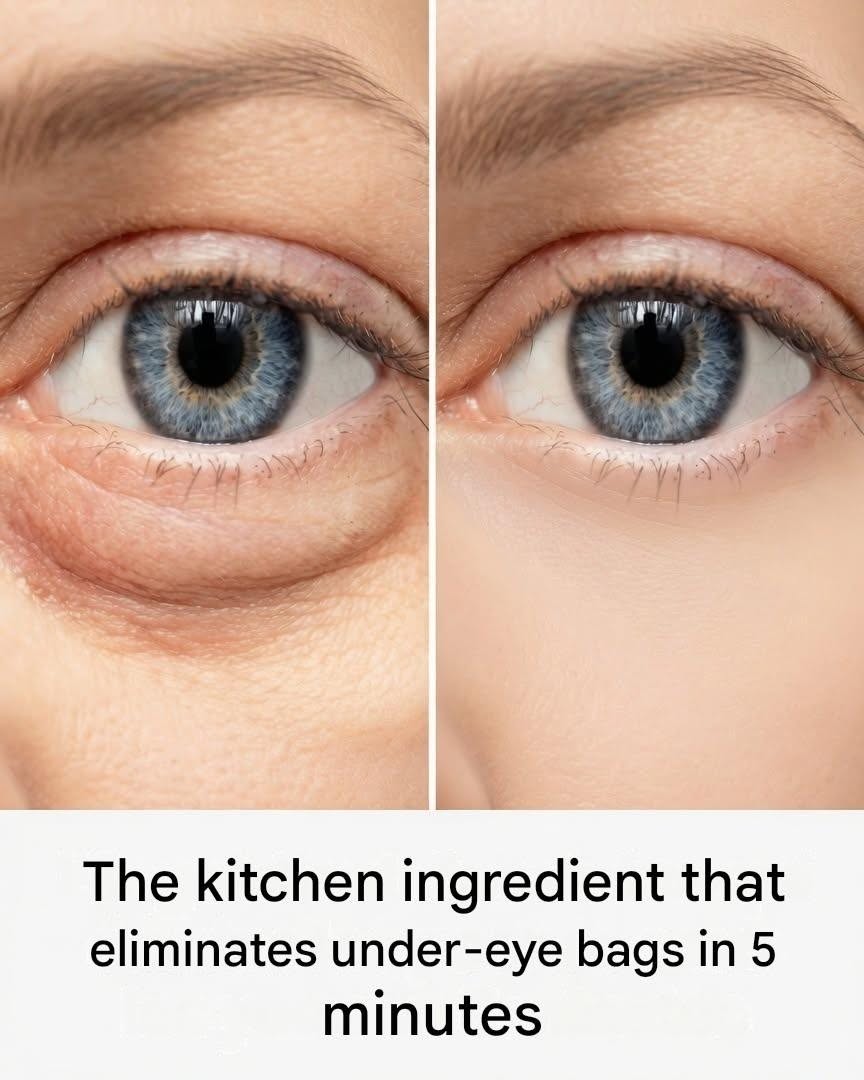
Did you know that 90% of people suffering from under-eye bags waste their money on expensive creams that don't work? And what's worse, they completely ignore an ingredient that everyone has at home, costs less than 2 euros, and can start working in just 5 minutes.
This discovery was made by accident, after years of waking up feeling like she'd been punched in both eyes. After trying €80 eye creams, spa treatments, and even considering cosmetic procedures without lasting success, a retired nurse shared a technique she'd been using in hospitals for over 30 years. Although it seemed too simple to be effective, the results appeared as early as the third day: no more swelling, no more puffiness, no more tired-looking eyes.
The seven hidden causes of puffy eyes
Puffy eyes are not just a cosmetic issue. They are actually a sign of a deeper problem. Most people think it's due to lack of sleep or drinking too much water before bed, but the reality is much more complex.
Cortisol and chronic stress are the main triggers. Even if you think you're not stressed, your cortisol levels can be extremely high. Your body interprets everything as stress: phone notifications, traffic jams, an argument from last week, and so on. Cortisol forces your body to retain water, which is then drawn first to the most delicate area of your face: the eye contour.
Hidden sodium is the second trigger. A single slice of regular bread contains more hidden sodium than a small bag of potato chips. Breakfast cereals are loaded with sodium, and a canned "healthy" soup contains more salt than your body needs for an entire week. The food industry has conditioned your taste buds to crave this amount of salt. Every gram of excess salt retains three grams of water in the body, and this retention first shows up in the eyes.
Inappropriate skincare products are the third factor. The skin around the eyes is ten times thinner than the skin on the cheeks. Most eye creams are far too thick for this delicate area. When you apply these thick creams, you're actually clogging the microscopic drainage system around your eyes. The more expensive and rich the cream, the greater the clogging.
Sleeping position also plays a crucial role. If you sleep on your side or stomach, gravity works against you all night. Fluid naturally accumulates on the side you're lying on. But it's not just a matter of gravity: sleeping on your side also restricts lymphatic drainage on that side of the face. This is why some people wake up with a swollen eye on the side they slept on.
The timing of hydration can paradoxically worsen the problem. Drinking a large amount of water right before bed prevents your kidneys from processing it quickly enough. Your body temporarily stores cortisol in your tissues, and the loose skin around your eyes is the easiest place for it to accumulate.
Hidden food sensitivities , particularly to dairy and gluten, are the sixth trigger. Even without a full-blown intolerance, you might have a mild sensitivity that manifests as inflammation around the eyes. To check for this, simply eliminate dairy for five days, then gluten, and see if the morning swelling improves.
Aging is the seventh factor that exacerbates all the others. With age, the structure that holds everything in place weakens. The tiny ligaments and muscles around the eyes, which act as a natural support system, lose their tone. The fatty pads under the eyes then begin to push forward, like the foundations of a house sagging.
Continue reading by clicking the ( NEXT 》 ) button below!