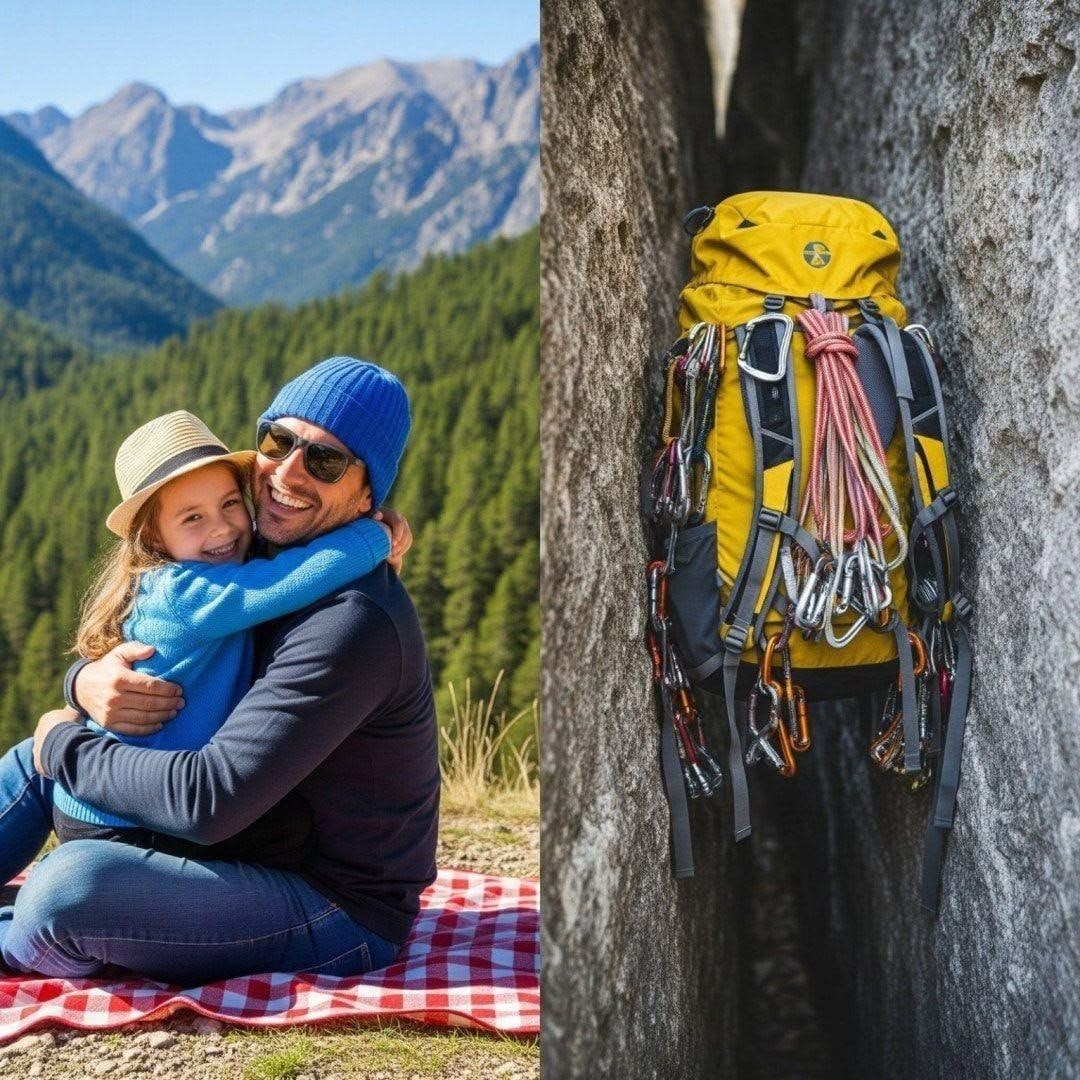
The media pressure returned with a vengeance. The family was alerted, and journalists from both sides of the border blocked the access roads. But the mountain wasn't about to give up answers easily.
The crevice where the backpack was found was barely fifty centimeters wide, but it extended several meters downwards and much further upwards. According to experts, it was possible that Julián had tried to descend at a nearby point looking for a shortcut or shelter, and that they had become trapped.
However, Captain Morel wasn't convinced. There was something odd about it: the backpack was barely damaged, with no signs of a long fall. Furthermore, the map included a pen mark that hadn't been present when the copies had been examined five years earlier.
"This doesn't add up," Morel whispered to one of the technicians. "If Julián wrote this after he got lost... we need to find out why."
The reopened investigation became a puzzle. And what the team found the next day, as they descended deeper into the crevice, completely changed the interpretation of the case.
The rescuers began their descent at dawn. They set up ropes, anchors, and thermal sensors. The crevice was narrow and damp, and every meter seemed to swallow the light. The sound of the wind faded as they descended, replaced by a heavy silence, as if the air had been trapped there for centuries.
At eight meters they found the first significant clue: a piece of red fabric, possibly part of Julián's windbreaker. It was torn, but not from a sudden fall; rather, it seemed to have been intentionally ripped off, like a mark or sign.
“This was deliberate,” Morel said. “Julian was trying to leave a trail.”
The theory fit with something that had always worried the family: Julian was an experienced hiker. It wasn’t logical that he would have disappeared on a moderately difficult trail. But if he had chosen an alternate route for some reason, perhaps to take shelter from a sudden storm, it would make sense that he would try to find his way using landmarks.
Three meters further down they found the second clue: a small metallic wrapper, with an expiration date two years after the disappearance. That left them perplexed. It seemed to indicate that someone—not necessarily Julián—had brought food there after 2020.
"Is it possible that someone used this crevice as a hiding place?" one of the technicians asked.
—Or that someone found Julián and Clara —Morel replied—. And didn't report it.
The descent became more difficult from that point. The crevice widened to one side, forming an irregular cavity. Shining a light on the area, they saw what appeared to be a small makeshift camp: remnants of a thermal blanket, an empty can, a short rope, and, at the bottom, a partially soaked notebook.
Morel opened it carefully. Many pages were illegible, but some words were distinguishable: “doesn’t go up,” “wait,” “wound,” “we hear voices.” There were no names, but the handwriting seemed to be Julián’s.
The most disturbing sentence appeared on a middle page:
“I can’t move. She must stay…”
The sentence ended there, cut off, as if Julián had abruptly stopped writing.
"Something serious has happened here," Morel said. "Julian was wounded, and Clara was still alive."
The most likely hypothesis was that they had been trapped after a partial fall. But something crucial was missing: none of the bodies were there. And given the depth of the cave, it was unlikely they could have gotten out on their own without leaving a trace.
While exploring the cave, one of the rescuers found markings on the wall: three vertical lines repeated several times, like a rudimentary code, possibly used to count days.