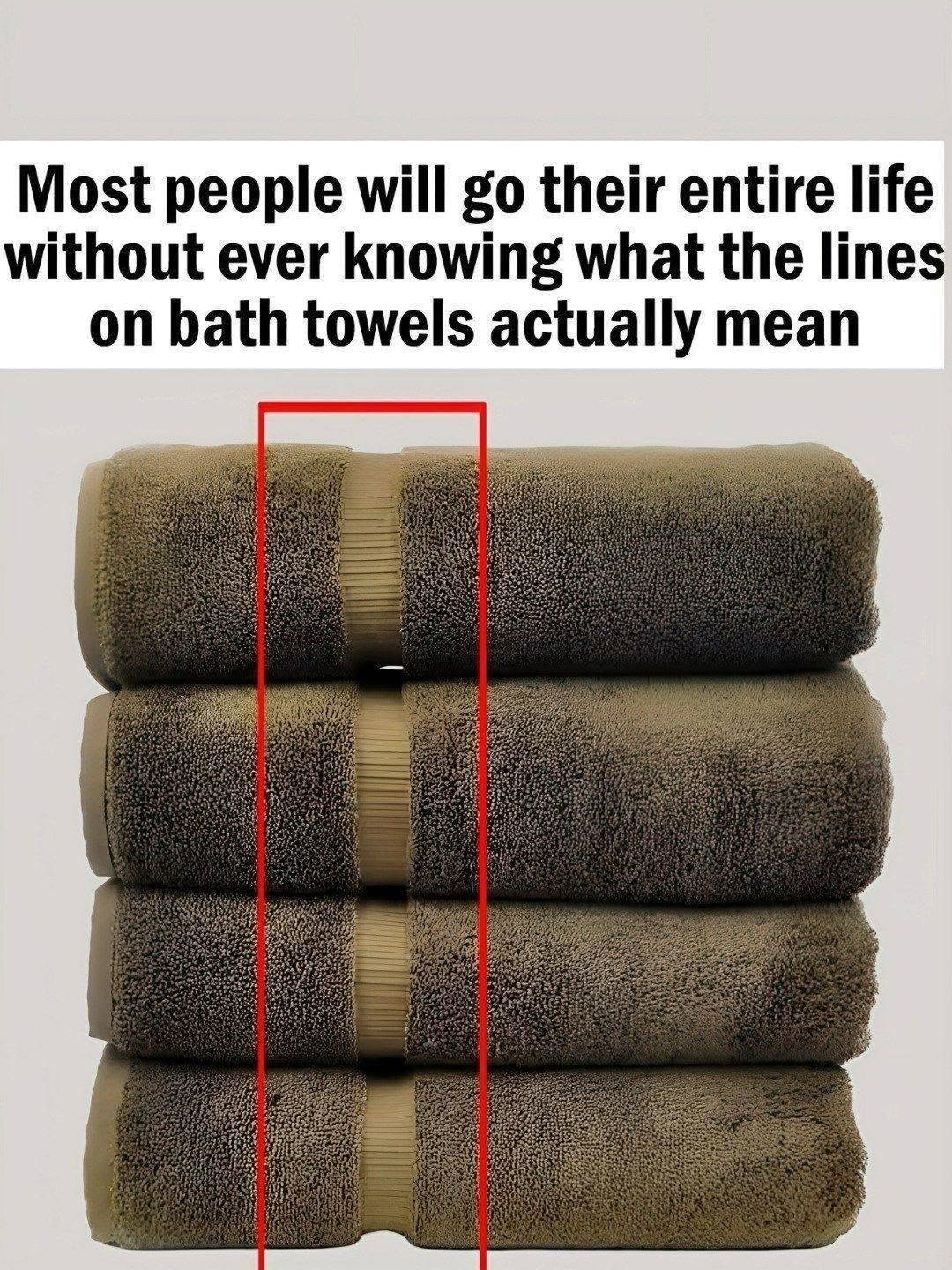
This contrast creates:
✅ Visual interest
✅ Structural reinforcement at the edges
✅ A designated "top" and "bottom" for proper hanging
Discover more
Health
Book
Books
🎨 The Color Code System: What Those Colored Lines Actually Mean
Now, here's where it gets interesting. In hotels—especially in Europe and at upscale properties worldwide—those colored bands aren't random. They're part of a size-coding system that helps housekeeping, laundry staff, and guests quickly identify towel types.
Standard Hotel Towel Color Codes
Band Color
Towel Type
Typical Size
Use
White (no band)
Bath sheet / Premium bath towel
35×60 in or larger
Luxury bathing; maximum coverage
White with colored band
Standard bath towel
27×52 in
Everyday bathing
Blue band
Hand towel
16×30 in
Drying hands at sink
Green band
Face towel / Washcloth
12×12 in to 13×13 in
Facial cleansing
Yellow band
Guest towel / Finger towel
11×18 in
Powder room; decorative use
Red band
Sport towel / Gym towel
Varies
Fitness facilities; poolside
Gray or Black band
Kitchen / Utility towel
Varies
Service areas; not for guest use
Discover more
Eggs
book
Candy & Sweets
💡 Important note: These color codes are not universal. They vary by hotel chain, region, and manufacturer. However, the system above reflects common European hospitality standards (particularly German and Austrian hotels, where standardization is taken very seriously).
Why Color Coding Matters in Hotels
✅ Efficiency: Housekeeping staff can quickly sort and restock towels without reading tags.
✅ Laundry organization: Industrial laundries process hundreds of towels daily; color bands help separate sizes and types.
✅ Inventory control: Managers can quickly assess if the right towel types are in the right places.
✅ Guest clarity: Visitors intuitively know which towel is for bathing vs. hands vs. face.
🏛️ A Brief History: Where Did This Tradition Start?
The practice of marking towels with bands dates back to the late 19th and early 20th centuries, when the modern hotel industry was formalizing standards.
Key Historical Moments:
1800s: European textile manufacturers began weaving decorative borders into linens as a mark of quality and craftsmanship.
Early 1900s: Grand hotels in Paris, London, and Vienna adopted standardized linen systems to manage large inventories.
Discover more
Health
Eggs
Chocolate
Mid-1900s: Color-coding became widespread in European hospitality, particularly in Germany, Austria, and Switzerland, where efficiency and order were (and still are) highly valued.
Today: The tradition persists in upscale hotels worldwide, though many properties now use embroidered logos or tags instead of (or in addition to) colored bands.
🌍 Fun fact: In some traditional European hotels, you'll still find towels with multiple colored stripes—each stripe representing a different attribute (size, quality grade, year of purchase, or even the specific floor or wing the towel belongs to).
🏠 What This Means for Your Home Towels
So, you're probably wondering: Do I need to care about these bands in my own bathroom?
Short answer: No, but you can if you want to.
If You Want to Adopt Hotel Standards at Home:
✅ Hang towels with the band at the bottom for a polished, uniform look.
✅ Use different colored towels for different purposes (even if they don't have bands):
Darker colors for face/body
Lighter colors for guests
Specific colors for gym/pool
✅ Invest in towels with dobby borders if you love the classic, tailored aesthetic.
If You Don't Care About the Bands:
That's totally fine too! Modern towels come in endless styles:
Borderless towels: Minimalist, modern look
Fringed edges: Bohemian or coastal vibe
Patterned or printed towels: Bold, decorative statement
Color-blocked designs: Contemporary aesthetic
The bands are a tradition, not a rule.
🔍 How to Identify Quality Towels (Beyond the Bands)
Whether your towels have decorative bands or not, here's what actually matters when assessing quality:
Factor
What to Look For
Why It Matters
GSM (grams per square meter)
400–600 GSM for everyday use; 600–900 GSM for luxury
Higher GSM = denser, more absorbent, heavier towel
Fiber type
100% long-staple cotton (Egyptian, Pima, Supima)
Longer fibers = softer, more durable, less pilling
Weave quality
Even loops; no loose threads; reinforced edges
Indicates careful manufacturing; extends towel life
Absorbency test
Water should soak in quickly, not bead up
Shows proper fiber treatment and weave structure
Durability
Maintains softness and absorbency after multiple washes
Quality towels improve with age; cheap ones degrade
💡 Pro tip: Avoid towels labeled "100% cotton" that feel stiff or waxy. They may be coated with sizing agents that wash out after a few uses, leaving you with a thinner, less absorbent towel.
🧼 Caring for Towels with Decorative Bands
If you have towels with woven bands or borders, here's how to keep them looking their best:
Washing Tips:
✅ Turn towels inside out before washing to protect the decorative border
✅ Use mild detergent; avoid bleach on colored bands (it can fade or discolor)
✅ Wash in warm water (not hot) to preserve fiber integrity and color
✅ Avoid fabric softener; it coats fibers and reduces absorbency over time
Drying Tips:
✅ Tumble dry on low or medium heat; high heat can weaken fibers and fade bands
✅ Remove promptly when dry to prevent wrinkles and musty odors
✅ Shake towels out before hanging to fluff the loops and maintain absorbency
Storage Tips:
✅ Fold with the band visible if you want a polished linen-closet look
✅ Avoid overcrowding shelves; towels need air circulation to stay fresh
✅ Rotate towels seasonally to prevent uneven wear
❓ FAQs: Your Towel Questions, Answered
Q: Can I cut the bands off if I don't like them?
A: Technically yes, but I don't recommend it. The bands often reinforce the towel's edge. Removing them could cause fraying or reduce the towel's lifespan. If you dislike the look, choose borderless towels next time.
Q: Do colored bands mean the towel is lower quality?
A: Not at all. The band color has nothing to do with quality—it's purely for identification or aesthetics. High-end luxury towels often feature elegant dobby borders in contrasting colors.
Discover more
Candy & Sweets
book
Book
Q: Why do some towels have two different colored bands?
A: Multiple bands can indicate:
Different sizes within a matching set
Hotel inventory codes (e.g., one color for size, one for year purchased)
Decorative design choice with no functional meaning
Q: Are towels without bands cheaper or lower quality?
A: No. Borderless towels are simply a different aesthetic. Many premium, minimalist brands specialize in clean, band-free designs. Quality depends on fiber, weave, and GSM—not the presence of a border.
Q: Can I match my towel bands to my bathroom decor?
A: Absolutely! Many manufacturers offer towels with bands in various colors (navy, sage, gray, blush, etc.) to coordinate with different design schemes. This is especially popular in European hospitality-inspired collections.
Q: Do all hotels use the color-coding system?
A: No. While common in Europe and at upscale properties worldwide, many hotels—especially in the U.S.—use embroidered logos, tags, or no identification at all. The system is a tradition, not a universal standard.
Q: Why are some towel bands raised or textured differently?
A: Raised bands are typically woven using a jacquard or dobby loom, which creates a decorative, textured pattern. This adds visual interest and reinforces the edge. It's a mark of quality craftsmanship.
🌟 The Bottom Line
Those lines on your bath towels aren't just decorative flourishes. They're a window into:
🏨 Hospitality history: A tradition born from European hotel efficiency and craftsmanship
🎨 Design intention: A way to create visual structure and polish in your bathroom
🧵 Textile heritage: A nod to centuries of weaving innovation and quality standards
Discover more
Dairy & Eggs
Books
Books & Literature
But here's the most important thing: Whether your towels have bands, borders, fringe, or nothing at all—what truly matters is how they make you feel.
Do they wrap you in comfort after a long day?
Do they absorb well and dry quickly?
Do they bring a smile when you step out of the shower?
If yes, then you've found the right towels—code or no code.
So the next time you reach for a towel and notice those subtle bands, you'll know: you're holding a small piece of hospitality history. And whether you hang it with the band at the bottom or toss it casually over the rack, it's still doing its job: keeping you clean, comfortable, and cared for.
And really, isn't that what matters most?
Here's What The Lines On Bath Towels Actually Mean